
You have invested your savings in a Fixed Deposit (FD) for better returns, but then an unexpected medical emergency, a cash shortage in your business, or another urgent expense arises, and you need cash immediately. The first thought that comes to mind is often “Can I break my FD before it matures?”
The good news is that most banks and financial institutions in Nepal allow Premature Withdrawal of fixed deposits. However, withdrawing your FD early usually comes at a cost. You may receive lower interest than expected, lose certain benefits, or even have to pay penalty charges depending on your bank’s policy.
In this blog, we will explain what happens when you break an FD before maturity in Nepal, how banks recalculate your interest, what penalties you may face, and the smarter alternatives you should consider before making a decision. Understanding these factors can help you avoid unnecessary financial losses while choosing the best option for your situation.
Premature Fixed Deposit withdrawal means closing your Fixed Deposit before its agreed maturity date, allowing you to access your money earlier than planned. Instead of waiting until the FD term ends, you request that your bank or financial institution release your deposit due to an urgent financial need.
In Nepal, this is commonly known as “FD pre-closure” or simply “breaking the FD”. Almost all commercial banks and development banks allow customers to withdraw their fixed Deposits before maturity. This provides flexibility in emergencies, such as medical expenses, business cash-flow problems, education costs, or other unexpected financial situations.
However, it is important to understand that just because premature withdrawal is allowed doesn’t mean it’s free. When you break an FD early, banks usually recalculate the interest based on the actual period your money remained in the deposit instead of the original FD rate. In many cases, they may also deduct a premature withdrawal penalty or impose other charges in accordance with their policy.
Before deciding to break your FD, it’s worth understanding how these interest adjustments and penalties work so you can avoid unnecessary financial loss and choose the most cost-effective option.
Although Fixed Deposits are meant to be held until maturity, life doesn’t always go as planned. Many people in Nepal choose to break their FD early because of unexpected financial needs or changing priorities. Here are some of the most common reasons:
Unexpected medical expenses or family emergencies often require immediate access to cash. When savings are not enough, many people choose to withdraw their fixed Deposit before maturity to cover hospital bills, treatment costs, or other urgent family needs.
Business owners may experience temporary cash shortages due to delayed customer payments, inventory purchases, or unexpected operating expenses. Instead of waiting for their FD to mature, they may break it early to maintain smooth business operations.
Sometimes interest rates increase, or a more attractive investment becomes available. If the potential returns from the new opportunity outweigh the cost of breaking the FD, some depositors decide to withdraw their funds early and reinvest elsewhere.
Applying for a loan can take time and may involve documentation, an approval process, and interest. Prematurely withdrawing their FD instead of borrowing from a bank.
Not everyone accurately predicts their future needs. Some depositors open a long-term fixed deposit without realizing they may need the money sooner. As a result, they end up breaking the FD before maturity to meet unexpected expenses or change financial goals.
Planning to open a Fixed Deposit but not sure which bank offers a better interest rate? Instead of checking rates bank by bank, compare the latest FD interest rates through Saral Banking Sewa and explore your options in one place. Find a rate that suits your savings goals before you lock in your money.
Many People believe that breaking a fixed deposit early results in just one flat penalty. However, that’s not how it usually works.
When you request a premature FD withdrawal, banks generally make two separate calculations before determining the amount you receive. First, they recalculate the interest you have earned, and then they may apply a premature withdrawal penalty.
Understanding both adjustments will help you understand why the final payout is often lower than expected.
When you open a fixed Deposit, the interest rate offered by the bank is based on the agreement that you’ll keep your money deposited until the maturity date. If you withdraw your FD before maturity, you no longer qualify for that original locked-in rate.
Instead, the bank recalculates your interest using the rate applicable to the actual period your money remained in the FD. For example, if you opened a 12-month FD but withdrew it after only 8 months, the bank will usually apply its 8-month FD interest rate instead of the original 12-month rate.
Since longer-term Fixed Deposits generally offer higher interest rates than shorter-term deposits in Nepal, this recalculation alone can significantly reduce the interest you earn even before any penalty is applied.
If you withdraw your FD within a very short period, such as a few days or weeks after opening it, you may receive very little interest or, in some cases, no interest at all, depending on your bank’s policy.
After recalculating your interest, many banks also charge a premature withdrawal penalty. This is a separate deduction and is applied in addition to the lower interest rate discussed above.
In Nepal, this penalty typically ranges from 1% to 3% of the applicable interest rate, though the exact percentage varies by bank. It is important to understand that this deduction is usually applied to the interest rate, not to your original principal amount.
Some banks may also apply different penalty rates depending on how long the FD has been active before withdrawal. That’s why the final amount you receive can differ even if two customers break their FDs on the same day.
When you combine the interest rate recalculation with the premature withdrawal penalty, the final payout is typically lower than what you would have received if you had kept your FD until maturity. Understanding these two separate adjustments can help you make a more informed financial decision before breaking your Fixed Deposit.
The biggest misconception about premature FD withdrawal is that you’ll only incur a small penalty. In reality, the reduction in your payout can be much larger because the bank first recalculates your interest at a lower rate and may then apply a premature withdrawal penalty according to its policy.
The simplified examples below show how breaking an FD before maturity can significantly reduce the amount of interest you earn.
| FD Amount (NPR) | Original FD Tenure | FD Rate | Withdraw After | Expected Interest at Maturity | Estimated Interest after premature withdrawal | Estimated Loss |
| 300,000 | 1 Year | 4% | 6 Months | 12,000 | 4,500 (3% recalculated rate) | NPR 7,500 |
| 500,000 | 2 Year | 5% | 10 Months | 50,000 | 16,667 (4% recalculated rate) | NPR 33,333 |
| 700,000 | 3 Year | 6% | 18 Months | 126,000 | 52,500 (5% recalculated rate) | NPR 73,500 |
| 1,000,000 | 4 Year | 7% | 2 Years | 280,000 | 120,000 (6% recalculated rate) | NPR 160,000 |
| 1,500,000 | 5 Year | 8% | 3 Years | 600,000 | 315,000 (7% recalculated rate) | NPR 285,000 |
Disclaimer: For illustration, the premature withdrawal interest rate is assumed to be 1% lower than the original FD rate. Actual calculations vary by each bank’s policy.
Before deciding to break your fixed Deposit, it’s important to understand that interest recalculation and penalties aren’t the only rules that may apply. Many banks in Nepal also have conditions regarding when you can withdraw your FD and how much notice you need to give.
Certain banks specify a minimum lock- in period after opening a Fixed Deposit. During this period, premature withdrawal may not be allowed, or you may not be eligible to earn any interest if you close the deposit too soon. This requirement is designed to discourage very short-term deposits and differs from one bank to another.
Some banks also require customers to submit a request several days before the FD can be closed. A notice period of around 15 days is common at some banks, although the exact requirement varies by institution. If you need funds urgently, failing to account for this notice period could delay access to your money.
Although every bank has its own FD policy, all commercial banks and financial institutions in Nepal must operate within the regulatory framework set by Nepal Rastra Bank. Some of NRB’s rules directly influence how fixed Deposits are offered and why premature withdrawal policies are fairly consistent across banks.
While the exact calculation differs from one bank to another, all licensed commercial banks operate under NRB’s regulatory and depositor- protection framework. That’s why it’s always important to read your FD terms and conditions carefully before investing and to understand the consequences of withdrawing your deposit before maturity.
If you withdraw your FD before maturity, the interest you earn is still considered taxable income. Even though your interest may be reduced because of interest rate recalculation and premature withdrawal penalties, the amount of interest that is actually paid to you remains subject to Tax Deducted at Source (TDS).
In practice, your bank will deduct the applicable TDS from the actual interest earned before crediting the remaining amount to your account. This means TDS is calculated on the reduced interest payout, not on the interest you would have received if the FD had reached maturity.
TDS rates and tax regulations may change over time. Always confirm the current TDS rate with your bank, or consult a qualified tax advisor for tailored advice to your specific financial situation.
If you have decided that premature withdrawal is the right option, the process is usually straightforward. While the exact procedure may vary slightly from one bank to another, most banks in Nepal follow these general steps.
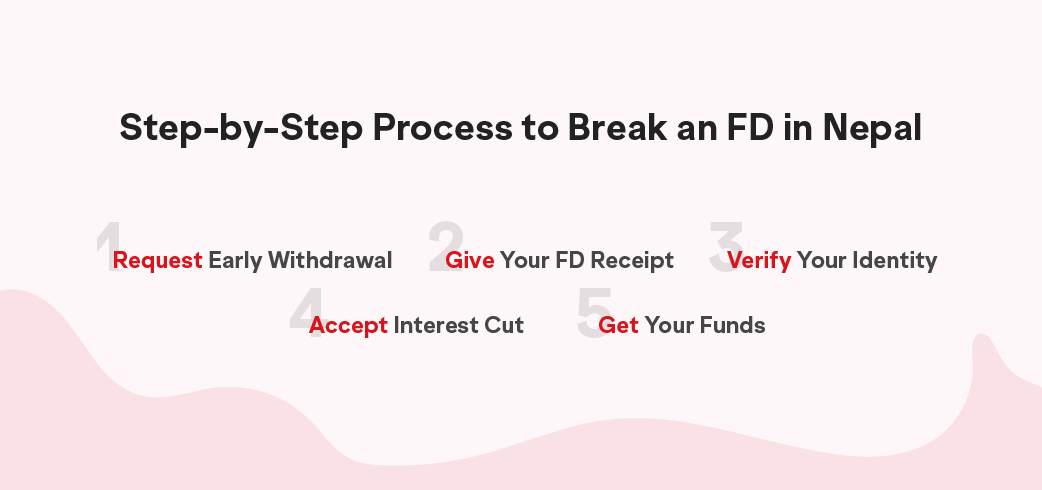
Visit your bank branch and inform the staff that you want to close your Fixed Deposit before its maturity date. Some banks also allow customers to request FD pre-closure through mobile banking or internet banking, making the process more convenient. Check with your bank to see if this digital option is available.
If your bank issued a physical Fixed Deposit receipt or certificate, you'll usually need to submit it along with a premature withdrawal request form. For digitally opened FDs, the bank may only require an online or written request.
The bank will verify your identity before processing the request. You may be asked to provide a valid identification document and confirm the details of the bank account linked to your Fixed Deposit.
Once your request is verified, the bank recalculates the interest based on the actual period your money remained in the FD. If applicable, it also deducts the premature withdrawal penalty in accordance with the bank's Fixed Deposit policy.
After completing the calculations, the bank credits the principal amount along with the eligible interest (after deductions) to your linked savings or current account. Depending on the bank's internal process, the funds are often available on the same day or within a few working days.
Before requesting premature withdrawal, ask your bank about any minimum lock-in period, notice requirement, applicable penalties, and the estimated amount you will receive. This helps you avoid surprises and make a well-informed financial decision.
Before closing your FD early, consider these alternatives that could help you access funds while minimizing your financial loss.
Many banks in Nepal offer loans or overdrafts secured by your FD, usually at your FD interest rate plus a small margin. This allows you to access the money you need while your FD continues to earn interest.
Some banks allow you to split your FD or withdraw only part of the deposit instead of closing it completely. This helps the remaining balance continue earning interest until maturity.
Instead of investing all your money in one long-term FD, spread it across multiple FDs with different maturity dates. This gives you regular access to funds without breaking a long-term deposit.
If you have emergency savings, consider using them first. This helps you avoid losing interest and paying penalties on your FD.
If your need for cash is temporary, a short-term loan or overdraft may cost less than the interest you lose by withdrawing your FD early.
Before breaking your FD, ask your bank about alternatives such as loans against FDs or partial withdrawals. They may help you meet your financial needs while protecting your investment.
A little planning before opening an FD can help you avoid unnecessary penalties and interest loss later. Keep these tips in mind:
Select an FD tenure that matches your financial goals and when you're likely to need the money. Avoid locking your funds away for longer than necessary.
Before signing the FD agreement, ask your bank about the minimum lock-in period, premature withdrawal rules, and any applicable penalty charges.
Instead of investing all your money in one FD, consider creating multiple FDs with different maturity dates. This gives you better access to funds during emergencies.
Maintain a separate account for unexpected expenses. This can help you avoid breaking your FD before maturity and protect your interest earnings.
Spending a few minutes understanding your bank's FD policy before investing can save you from costly penalties and reduced returns later.
Breaking your Fixed Deposit (FD) early in Nepal won't cost you your principal, but it can significantly reduce your returns. Your bank will typically recalculate your interest at a lower rate and may also apply a premature withdrawal penalty.
Before closing your FD, review your bank's terms and compare alternatives such as an FD-backed loan or overdraft. A little planning can help you access the funds you need while minimizing unnecessary financial loss.
Yes. Most banks in Nepal allow premature FD withdrawal, subject to their terms and conditions.
Many banks charge a premature withdrawal penalty, commonly 1% to 3% of the applicable interest rate, though it varies by bank.
Not usually. Your interest is generally recalculated at a lower rate, and you receive the eligible amount after any applicable deductions.
Some banks have a minimum lock-in period before premature withdrawal is allowed. Check your bank's policy.
Yes. Many banks offer loans or overdrafts against FDs, allowing you to access funds without closing the deposit.
Some banks allow partial withdrawals or FD splitting, while others require full closure. It depends on the bank.
To compare FD interest rates in Nepal, check the interest rate, deposit tenure, minimum investment, payout options, and withdrawal terms across different banks. Instead of visiting multiple websites, you can use Saral Banking Sewa to compare Fixed Deposit rates from various banks in one place and choose the option that best suits your financial goals.
Most commercial and development banks allow premature FD withdrawal, but the rules and charges differ by institution.
Banks usually apply the interest rate for the actual period your FD remained invested, which is often lower than the original rate.
No. However, TDS is deducted on the actual interest earned, even if the FD is withdrawn before maturity.
To calculate FD interest, you can use online calculation tools. You can enter your deposit amount, interest rate, investment tenure and get idea of how much interest you will get at maturity. For quick and accurate results, use the Saral Banking Sewa Fixed Deposit Calculator to estimate your returns before investing.