
A common belief among Nepali borrowers is that government banks always offer cheaper loans, while private banks are automatically more expensive. It sounds logical on the surface, but is it actually true?
The truth is, a bank’s base rate isn’t decided by who owns it. It’s shaped by a mix of factors, including how much the bank pays to collect deposits, its day-to-day operating costs, the liquidity it holds, the structure of its deposit base, and the overall lending strategy it follows. Ownership plays a role, but it’s just one piece of a much bigger picture.
Whether you are planning a home loan, business loan, education loan, vehicle loan, or personal loan, understanding what actually drives the base rate can save you from choosing a bank simply because of its reputation and help you pick one that genuinely offers you the best deal.
Let’s break down what really separates government banks from private banks when it comes to interest rates.
Before comparing government and private banks, it helps to understand what a “base rate” actually means because this single number is the foundation of almost every loan interest rate you will come across.
The base rate is a benchmark that banks use to set their lending rate. In Nepal, every bank calculates and publishes its base rate in accordance with guidelines set by Nepal Rastra Bank, the country’s central bank. This ensures a level of consistency and transparency across the banking sector.
So, what goes into this number? A few key factors:
A simple way to understand a loan rate is: Loan Interest Rate = Base Rate + Premium
For example, suppose a bank has a base rate of 5.5% and adds a 2.5% premium to a particular loan. The resulting interest rate would be approximately 8%.
The premium isn’t fixed; it changes depending on the loan product, the repayment period, whether collateral is involved, your profile as a borrower, and the bank's own internal credit policies. This is exactly why two people applying for the same type of loan at the same bank can still be offered different rates.
Since base rates are published regularly, borrowers can track changes over time and compare Nepali banks base rate before committing to a loan. To make this easier, Saral Banking Sewa brings together the latest base rates from banks across Nepal in one place, so you can compare your options without having to check each bank’s website separately.
Government banks are institutions in which the government holds substantial ownership or control, whereas Private banks are primarily owned by private investors and shareholders.
Both types are regulated by the NRB and must follow the same central banking framework. But beyond regulation, their management structures, customer bases, operating models, and business priorities often differ greatly.
| Factor | Government or state Banks | Private Banks |
| Ownership | Government or state-backed ownership | Private shareholders and institutional investors |
| Main Focus | Public service, financial access, and commercial banking | Profitability, growth, and market competition |
| Branch network | Often includes a broad national presence | Frequently concentrated in commercially active areas, though many have expanded nationwide |
| Operating | May have larger legacy | Often more focused on automation and operational efficiency |
| Customer perception | Strong public trust and institutional presence | Faster service, digital features, and competitive products |
| Base rate | Can be lower or higher depending on costs | Can also be lower or higher depending on efficiency and funding |
It's important to note that these are broad tendencies, not fixed rules. A government bank isn't automatically the cheaper option, and a private bank isn't automatically the pricier one. The actual base rate depends far more on how efficiently a bank manages its costs, deposits, and lending strategy than on who owns it.
This is exactly why comparing actual published rates, rather than relying on assumptions about ownership, is the smarter way to choose a bank.
Let's look at the actual factors that push a base rate up or down. These are the real reasons — not ownership, but operations.
Deposits are the fuel banks use to lend, with interest paid to savings and fixed-deposit customers. Large, low-cost deposits help banks lower their funding costs and base rates, while reliance on high-interest fixed deposits increases costs. Government banks benefit from stable, long-term deposit bases, but private banks with strong current and savings account portfolios can also be competitive.
Running a bank is costly due to salaries, rent, tech, security, and administration. Government banks often have extensive branches in low-volume areas and incur higher costs due to legacy systems or staffing. Private banks invest heavily in digital and centralized systems for efficiency, though upgrades are costly. The bank with leaner, more efficient operations can offer lower base rates, regardless of ownership.
Many borrowers overlook that not all deposits cost banks equally. Current accounts usually earn little to no interest, while savings and fixed deposits incur higher fees. A bank with more current and low-cost savings accounts has a funding advantage, even if its total deposits are smaller. Large deposits aren't always cheaper if they're in high-interest fixed deposits; the deposit mix matters as much as volume.
Liquidity indicates how much available money a bank has for withdrawals and loans. When deposits exceed loan demand, banks lower deposit rates, reducing fund costs and the base rate. Conversely, when liquidity is tight, banks raise deposit rates to attract funds, increasing costs and the base rate. These fluctuations affect the entire banking sector, with the NRB publishing interest rate data to reflect these shifts.
A broad branch network helps banks reach depositors nationwide, including in areas with limited access to digital banking. However, branches are costly. Private banks rely on mobile apps and centralized systems to reduce costs, while government banks benefit from broader reach and stronger ties but face higher costs of maintaining legacy infrastructure. Ultimately, the impact on the base rate depends on whether the branch network generates enough low-cost deposits to justify its costs.
Not all banks compete the same way. Some aggressively chase new borrowers with low rates to gain market share, while others focus on margins, risk, or a stable balance sheet. Private banks aim to serve profitable retail and business clients, whereas government banks balance commercial aims with public responsibilities such as priority lending. These strategies influence deposit costs, operating expenses, lending, and ultimately, the base rate.
No. This is one of the most common misconceptions among Nepali borrowers, and it's worth clearing up directly. A government bank can indeed provide a low base rate, but only under certain conditions. These include a strong foundation of low-cost deposits, high liquidity, controlled operating expenses, a loyal customer base, and efficient use of available funds. When these factors are aligned, the bank's base rate can genuinely be competitive.
The base rate isn't just a number banks publish; it directly shapes what you pay on a floating-rate loan each month.
Here's how it works. Your loan interest rate is simply the base rate plus a premium set by the bank. So if the base rate is 5.5% and the premium is 2.5%, your effective loan rate comes to 8%.
Base rates don't stay fixed forever; they move based on the deposit and cost factors we covered earlier. If the base rate drops to 5%, your loan rate could fall to around 7.5%. If it rises to 6%, your rate could climb to about 8.5%. The exact change depends on your loan agreement and how often the bank adjusts rates.
Even a small shift, like 0.5 percentage points, can make a real difference. On a large loan or over a long repayment period, that "small" change can add up to a noticeably higher or lower total interest cost over the years.
This is especially worth paying attention to for home loans, business loans, education loans, vehicle loans, and mortgage-backed personal loans, since these typically involve larger amounts and longer tenures, where rate changes have more room to compound.
Before you sign any loan agreement, it's worth asking your bank two simple questions: how often is the base rate adjusted, and will the premium stay fixed for the full loan term? Getting clear answers upfront can help you avoid surprises down the road and plan your repayments with more confidence.
Planning to take a loan? Before approaching a bank, take a moment to understand how much loan you may be eligible to borrow and whether your current financial profile meets typical lending requirements. You can also check your credit score with Saral Banking Sewa to get a clearer picture of your credit standing.
Here’s an important point many borrowers miss: the bank with the lowest base rate doesn’t always give you the cheapest loan.
Take a look at this example:
| Bank | Base Rate | Premium | Final Loan Rate |
| Bank A | 5.0% | 3.5% | 8.5% |
| Bank B | 5.5% | 2.0% | 7.5% |
Bank A has the lower base rate, but Bank B actually offers the better deal because its premium is smaller. The final loan rate is what really matters, not the base rate alone.
This is why comparing just the base rate can be misleading. To get the full picture, borrowers should consider several factors together.
Start with the current base rate and the premium charged on the loan, since together they determine your actual interest rate.
Then check the extra costs, processing fees, valuation and legal charges, and any insurance requirements tied to the loan. These add to your upfront cost even before interest comes into play.
Also look at early repayment charges and how often the rate gets adjusted, since both affect your flexibility and long-term cost.
Finally, compare the loan tenure, monthly installment, and total repayment amount. These numbers show what the loan will actually cost you over its lifetime.
In the end, the best loan isn't the one with the flashiest advertised base rate. It's the one with the most suitable total cost and repayment conditions for your specific needs.
There's no single right answer here; it genuinely depends on what you value and what's being offered to you at the time.
A government bank might be the better fit if you value an established branch network, strong public confidence, years of institutional experience, or a competitive rate on your particular loan category.
A private bank might suit you better if faster processing, convenient digital services, flexible customer support, or a specially priced loan offer matter more to you.
Rather than picking a side based on reputation, your decision should come down to the actual offer in front of you.
The smartest approach is to ask both government and private banks for a written loan quotation. Make sure you're comparing the same loan amount, tenure, and repayment structure across each offer; that's the only way to keep the comparison fair and meaningful.
Before you apply for any loan, it's worth going through a quick checklist to make sure you're making an informed decision.
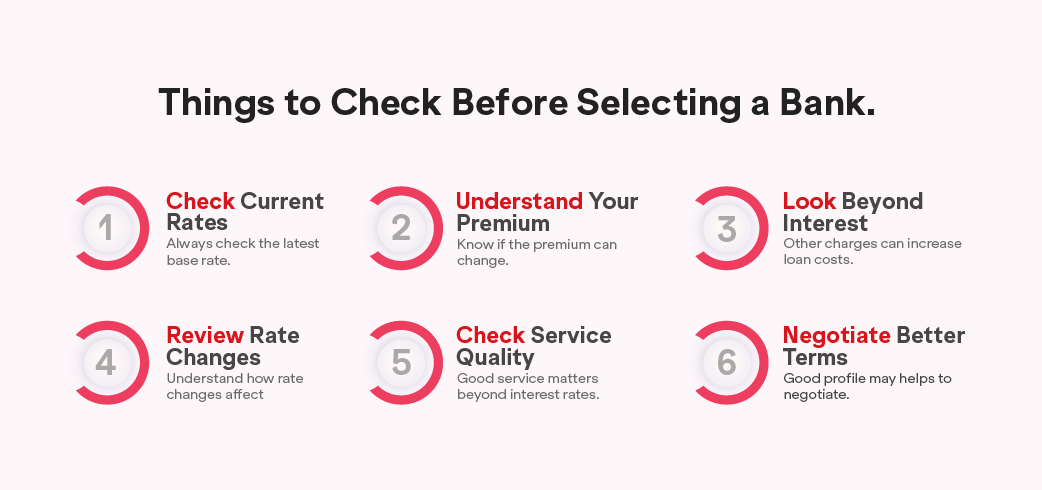
Base rates change over time, so don't rely on an old advertisement, a social media post, or a quotation you received months ago. Saral Banking Sewa offers a dedicated comparison page where you can review the latest base rates of banks in Nepal in one place.
Since the premium can significantly affect your final interest rate, always confirm whether it's fixed for the loan term or subject to revision later.
Don't stop at the interest rate alone. Factor in processing fees, insurance, legal expenses, valuation costs, and any other charges that come with the loan.
Ask the bank exactly how and when changes in the base rate will be reflected in your loan repayments.
A slightly lower interest rate isn't worth much if it comes with slow processing, poor communication, or inconvenient repayment services. Sometimes the better overall experience matters more than a marginal rate difference.
If you have a stable income, good repayment capacity, strong collateral, or an established relationship with the bank, you may be able to negotiate the premium or other charges in your favor.
At the end of the day, the government-versus-private-banks debate shouldn't be reduced to a simple belief that one category is always cheaper than the other.
Base rates differ because every bank has its own cost of deposits, operating structure, liquidity position, deposit mix, and business strategy. Ownership may play a role in shaping some of these factors, but it doesn't determine the final outcome on its own.
For borrowers, the smartest approach is to compare the latest base rate, premium, fees, and repayment conditions together, not in isolation.
So instead of asking only, "Which bank has the lowest base rate?", ask a better question: "Which bank is offering me the lowest total borrowing cost with suitable terms?"
That single shift in perspective can lead to a much smarter loan decision in Nepal.
Looking for a loan doesn’t have to mean checking different banks one by one. Apply for a loan through Saral Banking Sewa and save time by exploring suitable options in one place. We help make the loan process simpler, so you can focus on finding an option that fits your needs.
1. What is the difference between government banks and private banks?
Government banks are owned or controlled mainly by the government, while private banks are owned by private investors and shareholders. Both are licensed and regulated by the NRB, but they may differ in their operations, lending approach, and business priorities.
Every bank has different funding costs, operating expenses, liquidity levels, and lending strategies. These factors affect how each bank calculates its base rate, which is why government and private banks often have different base rates at the same time.
No. Government banks do not always offer the lowest loan rates. A private bank may offer a better overall deal, depending on the premium it charges and other loan fees. It's always best to compare the final borrowing cost rather than assume.
No. The base rate is only one part of your loan interest rate. Banks usually add a premium based on the loan type and borrower profile, so a lower premium can make a loan cheaper even if the base rate itself is higher.
Banks update and publish their base rates regularly in accordance with Nepal Rastra Bank guidelines. Since rates can change over time, it's a good idea to check the latest published base rate before applying for or refinancing a loan.
You can compare the latest base rates of commercial and development banks through Saral Banking Sewa. Viewing multiple banks side by side makes it easier to understand market trends and choose a lender that matches your borrowing needs.
Look beyond the base rate when comparing loans. Check the premium, processing fee, insurance cost, valuation charges, prepayment terms, loan tenure, monthly Installment, and total repayment amount; these factors together determine the actual interest rate.