

You have a good credit score, so does that mean the bank will approve your loan without any hassle? Many people believe that a high credit score is a golden ticket to loan approval. It’s a common assumption, but it’s not the whole picture.
A good credit score tells the lender that you’ve been responsible with credit in the past. It shows you pay your bills on time and manage debt well. But lending money is about more than just your history; it’s also about your present situation and your ability to repay in the future.
That’s where loan eligibility comes in. Lenders look beyond your score to assess factors like your income, existing debts, repayment capacity, and whether you meet the specific requirements of the loan you’re applying for. Even someone with an excellent credit score can be turned down for a loan if their income doesn’t support the repayment or if they already have too much debt on their plate.
So, credit score and loan eligibility are related, but they are not the same thing. In this article, we’ll break down exactly how they differ and walk you through each factor that lenders at Saral Banking Sewa consider before approving your loan, so you know exactly where you stand before you apply.
A credit score is a number that summarizes your credit history, basically a picture of how you’ve handled borrowed money in the past. It’s calculated using information from your credit report, which is maintained by credit bureaus on data shared by banks and financial institutions.
Several factors go into shaping this number:
Put together, these factors build a picture of your creditworthiness. Generally speaking, a stronger credit history, marked by timely payments and sensible debt management, translates into a higher score. It signals that you’ve been a disciplined borrower over time.
But here’s the important nuance: a credit score reflects your past behavior. It’s a useful indicator, not a guarantee of how you’ll manage a new loan going forward.
Banks typically review credit information before approving a loan, as it shows how someone has handled credit in the past, including repayment patterns and existing accounts. This helps lenders measure risk. Timely repayments suggest reliability, while missed payments may raise concerns. Still, the score is only one part of the assessment. Lenders usually weigh it alongside income, existing debt, and other financial details rather than relying on it alone.
Check Your Credit Score Before Applying: Knowing your credit score can help you understand your credit standing before applying for a loan or other financial products. Check your credit score online with Saral Banking Sewa and get a clearer picture of where you stand before approaching a lender.
Loan eligibility refers to the set of requirements a borrower must meet to qualify for a specific loan. It's broader than the credit score alone; lenders typically consider income, existing debt, repayment ability, and other aspects of a borrower's financial circumstances before making a decision.
Eligibility criteria aren't fixed across the board. They can vary depending on the lender and the type of loan, so what qualifies someone for one loan product may not apply to another.
It's also worth noting that meeting the basic eligibility requirements doesn't necessarily guarantee final approval. Lenders may still take additional factors into account before making a final decision.
Planning to apply for a loan? Get a quick assessment of your potential loan eligibility with Saral Banking Sewa’s Loan Eligibility Assessment. Enter your details to understand your eligibility and take the next step with more confidence.
When evaluating your loan application, lenders typically look at a combination of factors, not just your credit score, to get a complete picture of your financial standing. These commonly include:
Together, these factors help lenders assess not just whether you can be approved for a loan, but whether you’re likely to repay it comfortably, which is the real goal of the eligibility check.
While the two are closely related, credit score and loan eligibility aren't interchangeable. One is a narrower measure of past credit behavior, while the other is a broader assessment of whether a specific loan makes sense for a borrower right now.
A credit score indicates how a borrower has managed credit over time, largely shaped by repayment history and existing credit obligations. However, a high score reflects past behavior; it doesn't necessarily mean a borrower is currently in a position to take on another loan.
Loan eligibility takes a wider view, factoring in income, existing debt, repayment capacity, employment stability, collateral, and other lender-specific requirements. This is why two people with similar credit scores can end up with very different eligibility outcomes; one might have significant existing debt or unstable income, while the other doesn't.
A good credit score can strengthen a loan application, but it doesn't determine eligibility on its own. Ultimately, lenders make decisions based on their own criteria and a complete view of the applicant's financial profile, not any single factor in isolation.
| Credit Score | Loan Eligibility |
| Reflects a borrower’s credit-related history and behavior | Shows whether a borrower meets the requirements for a specific loan |
| Focuses mainly on Creditworthiness | Considers the borrower’s broader financial situation |
| Can be influenced by repayment history and existing credit obligations | Can depend on income, debt, repayment capacity, loan amount, and other factors |
| Is one factor lenders may consider | Includes multiple eligibility criteria |
| A good score can strengthen a loan application | Meeting eligibility criteria does not always guarantee final approval |
| Can help lenders assess credit risk | Helps lenders determine whether the borrower qualifies for the particular loan |
Yes, credit score plays a role, but it's rarely the only thing that decides an application. Lenders use it as one signal among several to gauge how an applicant has handled credit in the past.
Credit information gives lenders a quick way to assess risk. A track record of on-time payments suggests responsible credit management, which can work in an applicant's favor.
A low score can make qualifying harder, especially for certain loan products. But it doesn't automatically mean rejection; lenders often weigh other parts of the financial picture, such as income and existing debt.
No. A strong score helps, but lenders also look at income, current debt, repayment capacity, and sometimes collateral. For example, someone with an excellent score but very high existing debt may still struggle to get approved.
Credit score is only one input into a lender's decision. Most lenders build a fuller picture of an applicant by weighing several other factors alongside it, since a single number can't capture someone's complete financial situation.
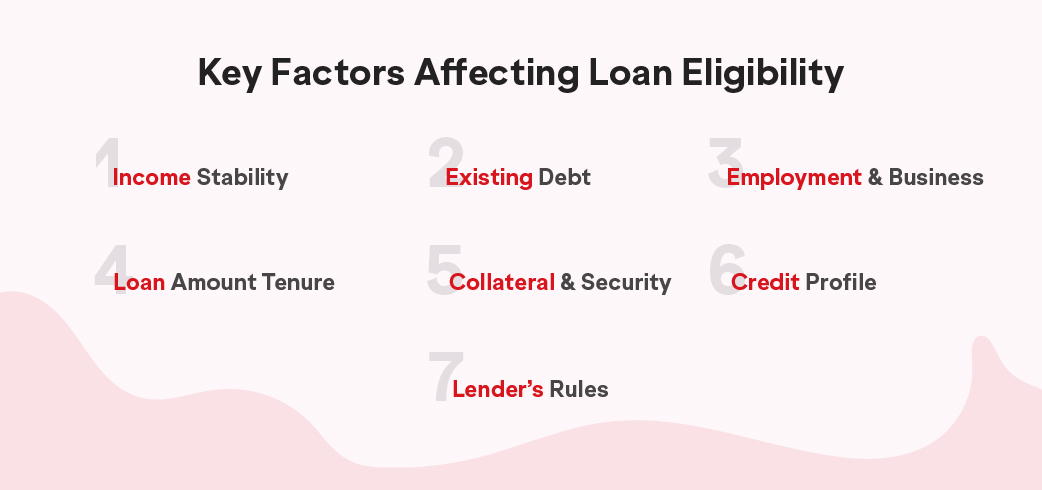
Before approving a loan, lenders want assurance that the borrower can manage repayments without strain. This means looking not just at how much someone earns, but at how stable and predictable that income is over time. A borrower with a high but irregular income may be viewed differently than one with a lower but steady, dependable income stream.
Any current EMIs, credit card balances, or other loans are factored into the amount of additional debt a person can realistically take on. This is why a borrower with an excellent credit score might still be offered a smaller loan amount, or face difficulty getting approved, if a large portion of their income is already committed to existing repayments.
Thinking about getting a credit card? Before applying, check whether your current financial commitments align with typical eligibility requirements. Use Saral Banking Sewa’s Credit Card Eligibility Assessment to get a better understanding of your eligibility and explore your options before submitting an application.
Lenders often look at how long someone has been in their current job or how established their business is. Consistent employment or business history suggests a lower risk of income disruption, which can make lenders more comfortable extending credit. That said, exact expectations around job tenure or business vintage vary widely from one lender to another.
The amount requested plays into how closely a lender scrutinizes the application; larger amounts naturally invite more careful assessment. Tenure matters too: a longer repayment period generally lowers the monthly installment, which can make a loan more manageable and, in turn, affect how the lender views the applicant's ability to repay.
For secured loans, offering collateral, such as property, a vehicle, or fixed deposits, gives the lender a safety net if repayments aren't made. This can sometimes offset weaker areas elsewhere in an application. Whether collateral is required and what form it takes depends heavily on the type of loan and the lender's policies.
Rather than fixating on a single score, many lenders review the broader credit history: how long credit accounts have been active, the mix of credit types used, and repayment patterns over time. This fuller history can offer more context than one number alone, and it's worth remembering that a score is a summary, not the complete story of someone's creditworthiness.
Eligibility criteria are not standardized across the industry; each bank or financial institution sets its own benchmarks for income, credit score, documentation, and more. Because of this variation, it's worth checking a lender's specific requirements directly before applying, rather than assuming the same criteria will apply everywhere.
A low credit score can make borrowing more challenging, but it doesn't rule out every possibility. What actually happens depends on the lender, the type of loan, and the borrower's broader financial profile.
A weaker credit profile often signals higher risk to lenders, since it may reflect past difficulties in managing repayments. This can lead lenders to assess an application more cautiously, sometimes resulting in stricter terms, lower loan amounts, or additional scrutiny of other financial details.
There's no universal rule that guarantees rejection just because of a low score. Lenders may still weigh factors like income, repayment capacity, existing debt, or collateral before making a decision. Since criteria vary, it's worth checking individual lender requirements directly to understand what's realistically possible.
It’s a common assumption that a strong credit score guarantees approval, but that’s not the case. A good score reflects how well someone has managed credit in the past; it doesn’t automatically confirm that a new loan fits their current financial situation.
Several practical factors can lead to rejection even with a strong score. Income may not be sufficient to comfortably support the requested loan, or a large share of it may already go toward existing debt, leaving limited repayment capacity. Unstable employment or fluctuating business income can also raise concerns, even when past credit behavior has been solid.
The loan requested itself matters too. Asking for an amount that doesn’t align with one’s overall financial profile can be a sticking point, as can failing to meet collateral requirements for secured loans. And since eligibility criteria differ across institutions, a borrower might simply not meet a particular lender’s specific requirements, regardless of how strong their credit score is.
Before applying, it helps to take stock of income, existing debt, and monthly financial obligations to get a realistic sense of repayment capacity. It’s also worth reviewing a lender’s complete eligibility criteria in advance, rather than assuming a good score alone will carry the application through.
Credit Score and Loan eligibility aren’t the same thing. A credit score reflects a narrower slice of the picture- how someone has managed credit in the past, while eligibility takes in the borrower’s broader financial situation as a whole.
Before applying, it’s worth looking beyond the score to income, existing debt, repayment capacity, and how these fit against the interest rates, fees, and specific requirements a lender sets.
Since loans differ widely in interest rates, fees, repayment terms, and eligibility criteria, comparing options side by side makes it easier to find one that genuinely fits. Saral Banking Sewa’s loan comparison features make this straightforward, letting readers weigh these details together before deciding where to apply.
No. A credit score reflects past credit behavior, while eligibility considers a broader set of factors, such as income, debt, and repayment capacity.
No. Lenders also assess income, existing debt, repayment capacity, and other requirements before approving a loan.
This varies by lender and loan product, so it’s best to check the specific requirements of the lender you’re considering.
It’s possible to get a loan with low credit score, though it may be more challenging. Approval depends on the lender, loan type, and your overall financial profile.
It gives lenders a sense of how you’ve managed credit in the past, which can influence their risk assessment, but it’s usually weighed alongside other factors.
Common factors include income, existing debt, employment or business stability, the requested loan amount and tenure, collateral, and credit history.
Yes. Reasons can include insufficient income, high existing debt, unstable employment, or failure to meet a lender’s specific criteria.
Yes, Lenders look at whether your income is sufficient and consistent enough to comfortably support the repayments.
Yes, Current EMIs and debt obligations reduce your additional repayment capacity, which can limit new borrowing.
Maintaining a healthy credit history, keeping existing debt manageable, ensuring stable income, and reviewing a lender’s requirements beforehand can all help.