
Banner image with the text "Your credit score explained - the key to loan approval" and the logo of Saral Banking Sewa
15 Apr, 2026

What is a Credit Score in Nepal and How is It Calculated?

Are you planning to take a loan? Whether it's for a new home, a car, or starting your dream business, there is one invisible number that stands between you and your approval: your credit score.

A Credit Score is a digital record that tells banks how responsible you are with money. In Nepal’s fast-moving banking world, your credit score is your "Digital Certificate" of trust. A high score acts like a VIP pass, unlocking lightning-fast loan approvals, higher credit limits, flexible collateral options, and the power to negotiate lower interest rates that can save you lakhs in EMIs. 

On the flip side, a poor history can land you on the "Blacklist," turning even a simple credit application into a major headache. So, in this guide, we’ll break down what a credit score is, how to check your score, what the 60 to 960 credit score means for your bank loans, and how the CIB uses your last 15 months of habits to judge your trust factor. 

That’s not all, we will also explore the "hidden risks," tips to boost your score, and find the official way to check your report so you can take full control of your financial future.

What is a Credit Score in Nepal?

A credit score is a numerical representation of your financial stability, primarily managed by the Credit Information Bureau (CIB) of Nepal. While the concept is similar to global systems like Fair Isaac Corporation (FICO) or Credit Information Bureau India Limited (CIBIL), the infrastructure in Nepal has specific characteristics. 

While international markets often use a range of 300 to 900, Nepal’s evolving financial landscape follows a unique scale:

  • The Range: Your score will fall between 60 and 960.
  • High Score (Closer to 960): This indicates an exceptional track record. You are the ideal borrower, likely to receive faster approvals and better interest rates.
  • Low Score (Closer to 60): This may indicate past defaults, late payments, or a lack of credit history.

This score is based on your credit behavior over the last 15 months, which is managed by CIB, which acts as the national repository for credit information from all banks and financial institutions (BFIs).

Who Calculates Credit Scores in Nepal?

In Nepal, your financial reputation is managed by CIB. Think of the CIB as a central, neutral library that keeps a record of every individual's borrowing behavior. They don't just guess your score; they act as a data hub where all licensed banks and financial institutions report your activity every month. 

Whether you’ve paid your EMI on time or missed a credit card payment, it all gets logged here to create your "financial report card." By centralizing this data, the CIB helps banks decide if you are a "safe bet," ensuring that responsible borrowers get better deals while maintaining the overall stability of Nepal's banking system.

Why is Your Credit Score Important?

Having a high credit score in Nepal is like carrying an “Exclusive Card" in the banking world. It proves to lenders that you are a person of your word when it comes to money. 

The credit score is your most valuable financial asset, and here is why:

  • Loan Approval: Whether you are applying for a Home Loan, Personal Loan, Business Loan, or Auto Loan, the bank’s first step is always a CIB check. If your score is high, the bank views you as a "low-risk" client. This leads to much faster processing times, less back-and-forth paperwork, and a higher chance of approval.
  • Lower Interest Rates & Negotiation Power: Borrowers with excellent scores are often offered the most competitive interest rates. Even a 1% or 2% difference in your interest rate can save you lakhs of rupees over the lifetime of a mortgage.
  • Credit Card Eligibility: When you apply for a credit card in Nepal, your score determines your spending power. Banks offer higher limits to those with a proven track record, providing a larger safety net for emergencies. You can instantly check your credit card eligibility by using the eligibility tool on Saral Banking Sewa.
  • Trust factor for banks and lenders: In the banking world, your credit score is the ultimate trust factor. It transforms you from a "stranger" into a reliable partner in the eyes of the lender. By proving your financial honesty through past behavior, you make it easier for banks to say "Yes" to your future dreams.

How is Credit Score Calculated in Nepal? 

Calculating a credit score isn't based on a single event; rather, it’s a mathematical analysis of your entire financial behavior over the past 15 months. In Nepal, CIB calculates this score by analyzing several key factors reported by your banks. 

The major factors that determine whether your score climbs toward 960 or slips toward 60 include:

1. Payment History

This is the most important factor in the calculation. Banks usually want to know: Do you pay your debts on time?

  • On-time Payments: Regularly paying your EMIs and credit card bills builds a strong foundation.
  • Days Past Due (DPD): The CIB tracks if you are 30, 60, or 90+ days late. In Nepal, even a few days' delay can be flagged in your 15-month history.
  • Negative Marks: Serious issues like check bounces or being "Blacklisted" for defaults will cause your score to crash instantly.

2. Credit Utilization

This factor looks at how much of your available credit you are actually using, especially on credit cards. 

  • The Danger Zone: If you have a credit limit of NRs 2 Lakhs and constantly use NRs 1.9 Lakhs, you appear "credit hungry" to banks. This high usage signals that you’re overly dependent on debt, which can make lenders nervous and quietly pull your score down.
  • Best Practice: Keeping your usage below 30% of your total limit signals to banks that you are in control of your finances and not living beyond your means.

3. Credit History Length

The longer you are part of the formal banking system, the more data you provide to prove you are a reliable borrower through a history of successful repayments. This is why your first loan or credit card is an important step in building your "digital certificate of trust."

4. Credit Mix 

Banks like to see that you can handle different types of debt at once. A healthy mix might usually include:

  • Secured Loans: Such as a home or auto loans.
  • Unsecured Loans: Such as credit cards or personal loans. Successfully managing both shows that you are a versatile and disciplined borrower.

5. New Credit Inquiries

Every time you apply for a loan, the bank makes a "Hard Inquiry" to the CIB. If you apply to five different banks in a short period, it suggests you might be in financial distress, which can temporarily lower your score and act as a red flag for lenders.

What is a Good Credit Score in Nepal?

Understanding where you fall on this scale is essential before you apply for a loan, as each category changes how a bank looks at your financial health.

The Scoring Categories: 

  • Excellent Credit Score: It is between 750-850, which shows that you have a flawless 15-month history. You likely pay every bill before the due date and use your credit cards excellently. In Nepal’s competitive banking market, banks might even reach out to you with pre-approved offers for vehicle or personal loans.
  • Good Credit Score: It is between 650 and 749, and the most disciplined professionals in Nepal fall into this category. You might have had a very minor delay once, or perhaps you carry a bit of debt, but you are consistent. You are highly likely to get that Home Loan or Credit Card approved without any stress.
  • Average Credit Score: It falls between 550 and 649, which suggests some inconsistencies, such as paying bills just within the 30-day window or applying for too many loans recently. Banks will look at your application more closely and might be less flexible with your collateral valuation or interest rate negotiations.
  • Poor Credit Score: It is below 550, and this range is usually the result of serious late payments (90+ days), check bounces, or a history of being Blacklisted. If you are in this category, your primary focus should be credit repair.

Quick Summary

Score Range Category Bank’s ViewImpact on Loan 
750-850Excellent Star Borrower Lowest Rates, Fast Approval
650-749Good ReliableStandard Rates, Easy Approval
550-649Average RiskyHighest Rates, More Paperwork
550 belowPoorHigh RiskLikely Rejection/ Blacklist

Common Mistakes That Lower Your Credit Score

Even if you have a high income, certain habits can act as "Invisible risks" for your credit standing. In the eyes of CIB, consistency is more important than the size of your paycheck. 

The most common mistakes that can put you in the score down and how you can avoid them.

  1. Missing or delaying EMI payments: This is the fastest way to damage your score. Many people think being "just a few days late" doesn't matter, but banks report your status based on DPD (Days Past Due). Even a two-day delay is recorded. 
  2. Using your full Credit limit: Maxing out your credit card makes you look "credit hungry," suggesting you are overly dependent on borrowed money.
  3. Applying for Too Many Loans: Applying to five different banks at once, hoping one will say "yes," is a major red flag. Each formal application triggers a "Hard Inquiry," and multiple inquiries in a short window suggest financial desperation.
  4. Not checking your credit report: Borrowers often believe that once a defaulted loan is paid, their score jumps back up instantly. Furthermore, in Nepal, Check Bounces can lead to serious legal consequences and an immediate spot on the CIB Blacklist. After clearing a debt, always get a No Objection Certificate (NOC) from the bank.
  5. Closing Old Accounts Unnecessarily: You might think closing an old, unused credit card "cleans up" your profile. However, this shortens your credit history, making you look like a less experienced borrower.
  6. Being a “Defaulting” Guarantor: In Nepal, being a guarantor is a serious legal commitment, not just a formality for a friend. If the person you guaranteed fails to pay, it reflects directly on your credit report.
  7. Settling Instead of Paying in Full: Sometimes, banks offer a "Settlement" where you pay less than the total amount owed to close a bad debt. While the debt is "settled," it remains on your CIB report as a negative mark for years.

How to Improve Your Credit Score in Nepal

If your current score isn’t where you want it to be, don’t worry, a credit score is a living number, not a permanent scar. Because the system in Nepal focuses heavily on your behavior over the last 15 months, you can significantly transform your financial reputation with a year of disciplined habits.

Here is your roadmap to rebuilding and improving your credit score: 

  • Pay EMIs on time: This is the single fastest way to see your score rise. Set up reminders or auto-debit instructions through your bank or apps like connectIPS. If you cannot pay the full balance, always pay at least the Minimum Amount Due before the deadline to avoid being flagged as a “negligent" borrower.
  • Keep Credit Utilization Low: Try to keep your spending below 30% of your total credit limit. Example: If you have a limit of NRs 1 Lakh, try not to let the balance exceed NRs 30,000. If you have a big purchase coming up, consider paying off a portion of your bill before the statement is even generated to keep the reported balance low.
  • Avoid Multiple Loan Applications: Every time a bank pulls your CIB report, it counts as a "Hard Inquiry," which can shave points off your score and make you look desperate for credit.
  • Maintain Long-Term Accounts: Avoid closing your oldest credit card or bank account, even if you don’t use it often. These old accounts provide the "Credit Age" your score needs to look mature and stable to lenders.
  • Regularly check your credit report: You can request your report directly from CIB or through your bank. By reviewing it once a year, you can spot errors early and have them corrected before they stop you from getting an important loan.

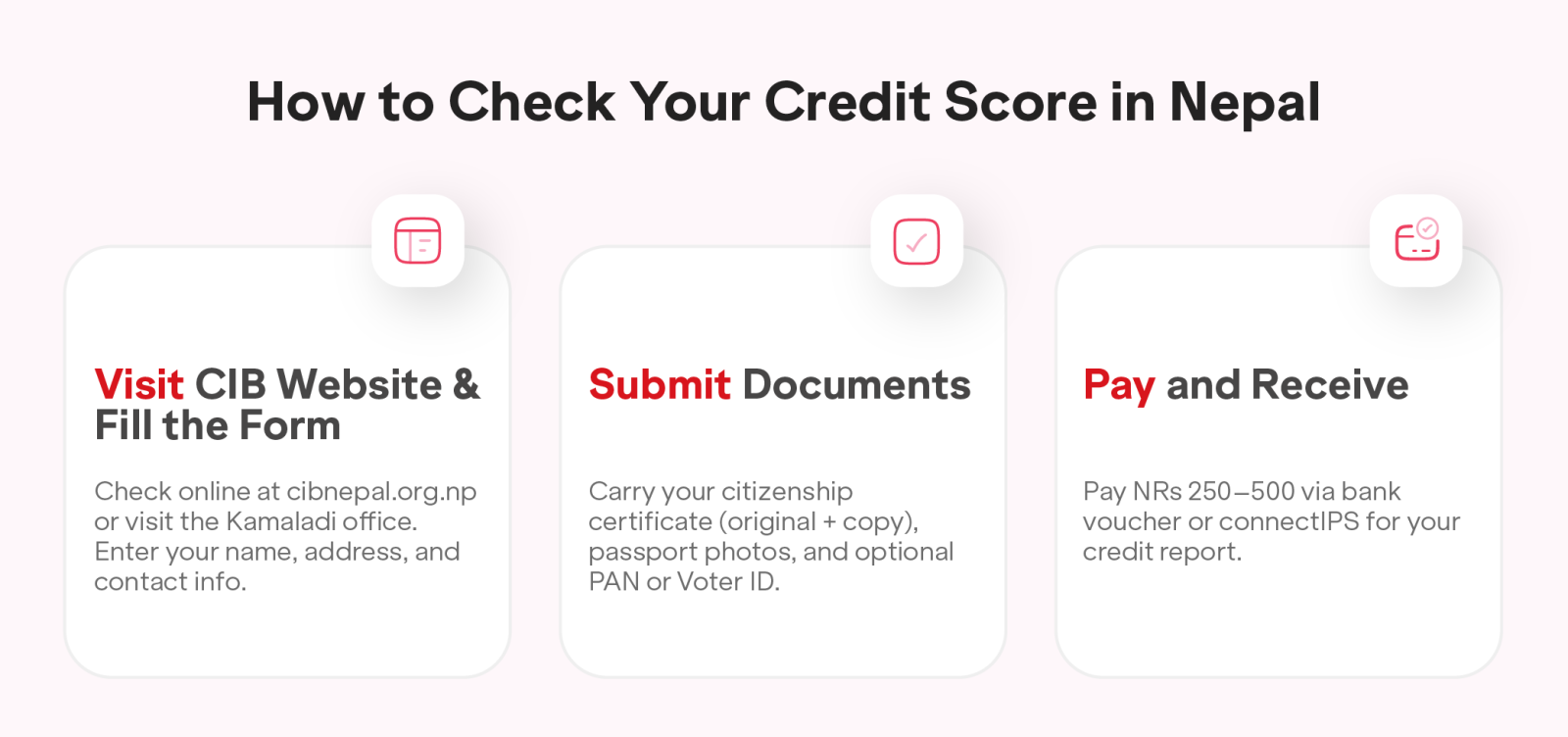
How to Check Your Credit Score in Nepal

Knowing your credit score is the first step toward financial empowerment. The official way to check your credit score in Nepal is by visiting the official website of CIB. 

  • You can visit their official website at cibnepal.org.np to find the latest forms and contact details, or visit the CIB office, which is located in Heritage Plaza, Kamaladi, Kathmandu.
  • You will need to fill out a form with your basic details, such as your full name, permanent address, and contact information.
  • Bring the original and a photocopy of your citizenship certificate, recent passport-sized photographs, (Optional: PAN Card or Voter ID for additional verification).
  • The fee for an individual report typically ranges from NRs 250 to 500, depending on whether you want a basic or detailed report. Payments can usually be made through bank vouchers or digital systems like connectIPS available at the counter.

Finally, once you receive your report, read it carefully. Look for: 

  • Loans you’ve already paid off that are still showing as "Active".
  • "Overdue" amounts that you know you have already settled.
  • Any loans or credit cards listed that you never took out.

How Credit Score Affects Loan Interest Rates

Most people know that a good credit score helps you get a loan. But what many don't realize is that it also determines exactly how much that loan will cost you in the long run. In the financial world, your credit score is the primary tool banks use to set your interest rate.

The Risk Logic: High Score vs. Low Score

  • High Score means Low Risk: When you have a strong CIB report, you are a "safe bet." To win your business, banks often offer a lower interest rate to keep you as a customer.
  • Low Score means High Risk: If your history shows missed payments, banks see a higher chance of default. To protect themselves, they charge a higher "Risk Premium" on top of the base rate, making your loan more expensive.

Having an excellent credit score isn't just about pride; it’s about massive financial savings. Here is how it helps:

  • Lower EMIs: Even a 1% or 2% difference in interest rates can significantly lower your Equated Monthly Installment (EMI). For a 20-year home loan, this small percentage difference can save you lakhs of rupees over the lifetime of the mortgage.
  • Negotiation Leverage: When your score is near 800 or 900, you are a "Star Borrower." You aren’t just asking for a loan, but banks are competing for you. You can use your score as leverage to ask for a reduction in the premium rate or a waiver of processing fees.
  • Access to Premium Products: Certain financial products, like "Gold" credit cards or unsecured professional loans with rock-bottom rates, are only available to those with top-tier credit scores.

Before you walk into a bank and start a formal application, it is a smart move to get an estimate of where you stand. Saral Banking Sewa offers a specialized tool to help you understand your creditworthiness from the comfort of your home. Use the Saral Credit Assessment Tool to get a better idea of your financial health before making your big move.

Tips Before Applying for a Loan

Applying for a loan is a major life decision. A little preparation today can save you from years of high interest and financial stress tomorrow. Before you sign on the dotted line, follow these important steps to ensure you are getting the best deal possible.

  • Check your score first: Don't wait for the bank to tell you that you've been rejected. Your first step should always be a CIB Self-Inquiry Report, which you can request directly from or through your bank. Knowing your score gives you the confidence to negotiate.
  • Verify Your "Blacklist" Status: Ensure any past disputes or settled loans have been officially cleared from the CIB records. If you’ve recently settled a debt, double-check that you have your NOC in hand. A small administrative error at a bank should not be the reason your new loan gets stalled.
  • Improve Your Score if Needed: Since the CIB tracks your behavior over a 15-month window, even six months of perfect, on-time payments can give your score a much-needed boost. Waiting a few months to improve your score today could mean a significantly lower interest rate for the next 10 to 20 years!
  • Compare interest rates across banks: In Nepal, money isn't priced the same everywhere. Look beyond just the advertised interest rate and compare like the base rate & premium, processing Fees, and Fixed vs. Floating Rates.
  • Borrow only what you can repay: It's tempting to take the maximum loan amount offered, but remember that every Rupee must be paid back with interest. To stay financially safe, your total monthly EMI should ideally stay within 30% to 40% of your net income. This ensures you have "breathing room" for emergencies or economic changes. To plan your budget accurately, you can easily calculate your monthly payments using the EMI Calculator on Saral Banking Sewa.

Conclusion

In Nepal's changing financial world, your credit score is more than just a number; it is your financial reputation. Think of it as your digital resume that tells banks exactly how much they can trust you.

As we’ve explored, maintaining a high score is the key to unlocking faster loan approvals, higher credit limits, and lower interest rates that can save you lakhs of rupees over time. Whether you are dreaming of a new home, a vehicle, or a business venture, your past financial behavior will pave the way for your future success.

Remember, a credit score is not static. By practicing good financial habits, paying your EMIs on time, keeping your credit usage low, and avoiding unnecessary loan applications, you can build a "Digital Certificate" that opens doors across the banking sector.

Take the first step today. Before you apply for your next loan, get a clear picture of where you stand. 
Use the Saral Banking Sewa Credit Score Checker to assess your creditworthiness from the comfort of your home and ensure you’re always in the best position to negotiate.

Frequently Asked Questions (FAQs)

1. What is the minimum credit score required to get a loan in Nepal? 

While there is no "official" minimum mandated by the central bank, most commercial banks in Nepal prefer a score of 650 or above.

2. Can I get a loan with a low credit score?

Yes, but it is much harder. With a low score, banks may ask for higher collateral, charge a higher interest rate, or require a strong guarantor. Some digital-first lenders or microfinance institutions might consider your application, but the terms will likely be less favorable than for someone with a high score.

3. How often should I check my credit score?

Check it once a year or at least 3–6 months before applying for a major loan (like a home or business loan). This gives you enough time to fix any mistakes or improve your score before the bank sees it.

4. Can I improve my credit score quickly?

There are no "instant" fixes because the CIB tracks your behavior over a 15-month window. However, you can see a significant boost in 6 to 12 months by paying all your EMIs exactly on time and keeping your credit card usage below 30%.

5. How long does it take to clear my name from the CIB Blacklist?

Once you settle your debt and your bank submits a No Objection Certificate (NOC) to the CIB, it typically takes 30 to 90 days for the records to be updated and your name to be officially removed from the blacklist.

6. How can I check my credit score online?

Currently, official reports are primarily issued through physical visits to the CIB office or through your bank. However, you can get an instant estimate of your credit standing using the Saral Banking Sewa Credit Score Checker. It’s a fast, user-friendly way to understand your creditworthiness from home.

7. Which score is considered a "Good" credit score?

In Nepal’s 60–960 range, a score between 650 and 749 is considered "Good." If you are above 750, your score is "Excellent," making you a top-tier candidate for the best banking deals.

8. What is a "Poor" credit score?

A score below 550 is generally considered poor. This is usually the result of multiple late payments, check bounces, or being previously blacklisted. If you are in this range, you should focus on credit repair before applying for new debt.