
Imagine finding your dream home in Nepal. You have a steady salary, but when you apply for a loan, the bank says "No." The reason? Your Credit Information Bureau (CIB) report. In 2083, a "good income" is no longer enough; your financial reputation and your credit score are what truly open doors.
The CIB acts as the central "scorekeeper" for your finances. It records every loan payment and credit card bill you handle. Before a bank approves your request, they check your CIB report to see your "financial report card" and determine how much it can trust you.
Having a strong credit history is a major money-saver. Borrowers with high scores can often negotiate lower interest rates and reduced processing fees. Even a small 1% difference in interest on a long-term home loan can save you lakhs of rupees over time, making your dream projects much more affordable.
In short, your credit score is a silent asset that opens doors. A clean record leads to faster loan approvals and gives you the power to negotiate better terms with any bank. By managing your payments carefully today, you ensure that the banking system is ready to support your future goals.
Unlike many other countries, Nepal does not have a universal, consumer-facing credit score. You won't find a single "magic number" that follows you from bank to bank. Instead, the process is centralized through the CIB Nepal.
In Nepal, your creditworthiness isn't measured by a single number like a FICO or CIBIL score. Instead, the process is managed by the CIB. Established in 1989 under Nepal Rastra Bank, the CIB acts as a central database where 124 member banks and financial institutions share your borrowing history.
When you apply for a loan, the bank pulls your records from the CIB to see if you pay your debts on time. Rather than using a universal score, each bank uses this CIB data to create its own internal credit score, weighing factors such as your income and repayment habits according to its specific rules. Essentially, while you don't have a public score, your financial reputation is tracked and shared across the entire banking industry.
Think of a CIB report as your financial “character certificate”. It tells banks exactly how reliable you are with money. Here is a simple breakdown of the specific credit history tracking components that make up your report:
Your record at the CIB is more than just a report; it is your strongest negotiating tool. Having a clean history doesn’t just get you a “yes” from the bank; it saves you a fortune.
Being on time with payments is crucial for your credit history. In Nepal, banks pay attention not just to whether you pay, but also to when you pay. Even a slight delay can affect your future loan applications.
Banks use a specific timeline to judge your reliability. The longer you wait, the worse the damage:
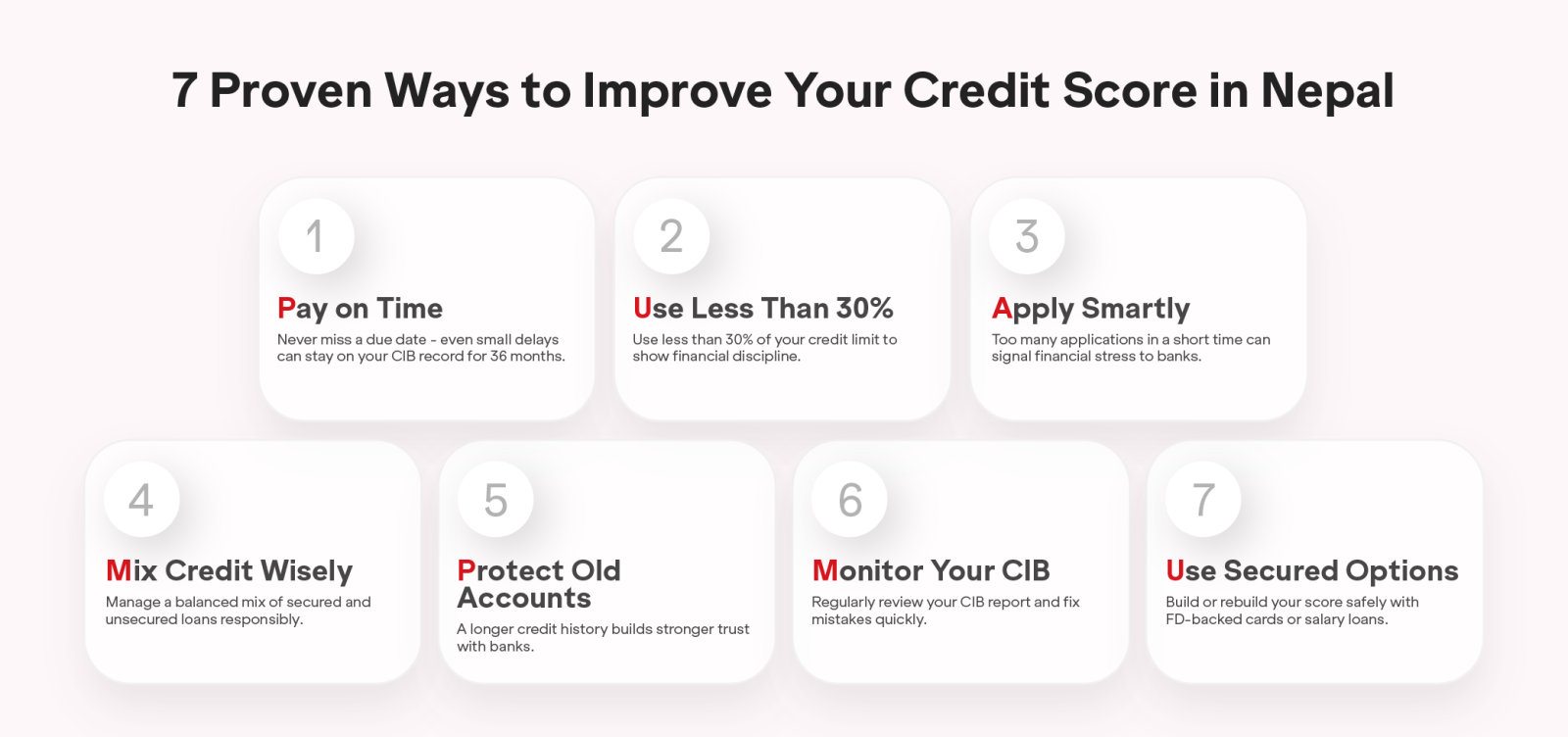
Remember, every late payment sticks to your CIB report for 36 months.
Real-Life Example: Ramesh had a personal loan with only three 15-day delays back in 2024. When he applied for an NPR 50 lakh home loan in 2026, the bank only approved NPR 35 lakh. Despite his high income, the bank cited "payment inconsistency" as the reason they couldn't trust him with the full amount.
Practical Strategies for On-Time Payments
Missing a payment is often just a matter of forgetfulness, but the impact on your reputation is real. Here is how you can stay ahead:
Even if you pay your bills on time, using too much of your available credit can make banks nervous. This is measured by your credit Utilization Ratio, which shows how much of your credit limit you are actually using.
The formula is simple: (Total Credit Used ÷ Total Credit Available) × 100
For example, if you have a credit card with a limit of NPR 200,000 and you spend NPR 40,000, your utilization is 20%.
Strategies to Lower Your Credit Utilization
Keeping your credit usage low doesn’t mean you can’t spend; it’s about how and when you pay. Here are three ways to manage your ratio effectively:
Every time you apply for a loan or a credit card, the bank inquires into your CIB report. While it might seem harmless to “shop around” at five different banks, the CIB tracks every single one of these searches.
Smart Loan/ Credit Application Strategy
Applying for a credit card or a loan should be a calculated move, not a “hit or miss” experiment. Here is how to apply strategically to keep your reputation intact:
In the Nepali banking system, showing that you can manage different types of debt makes you appear to be a responsible borrower. A “credit mix” is simply the variety of loans you have, which generally fall into two categories.
Secured credit refers to loans that are backed by an asset, meaning there is something of value, like a house or car, that the lender can claim if the borrower fails to repay. Examples include home loans and auto loans. On the other hand, Unsecured credit relies on the borrower's reliability and does not require any collateral. This type includes credit cards and personal loans, which are given based solely on the borrower's creditworthiness.
While variety is good, it should happen naturally over time. Here is how to handle it wisely:
In the world of banking, age equals trust. The Length of credit history is a key factor banks use to see how you handle money over time. When you close your oldest credit card or account, you accidentally “erase” years of proof that you are a reliable borrower. The Tenure Advantage: Think of your credit history like a career resume:
Tips to Manage Old Credit Accounts
Even if you don’t use your oldest credit card much anymore, keeping it open is a smart move. Here’s how to do it without the hassle:
Your financial reputation is only as good as the data in your report. Mistakes happen more often than you think, and a simple typo could cost you a loan approval.
Step-by-Step Correction Process
The CIB Nepal serves as a central database, but because it only records what banks report, errors can occur. Correcting them is a formal process that requires coordination between you, your bank, and the CIB.
If the bank doesn’t respond within a week or refuses to fix a clear error, you have the right to take it higher. You can file a complaint with the NRB Department or its Dispute Resolution Committee.
If you are new to banking or rebuilding your reputation, "Secured Credit" is the safest way to start. Since these options are backed by your own assets, banks are much more likely to approve them quickly. Here are the four most common secured options in Nepal:
Maintaining a strong credit profile isn't just about what you do right; it’s about avoiding the small slips that banks watch closely. Here are the most common mistakes that can quietly damage your standing:
Building a strong financial reputation in Nepal doesn't happen overnight; it is the result of consistent, small habits. By paying on time, keeping your debt low, and monitoring your CIB report, you prove to banks that you are a disciplined and trustworthy borrower.
A healthy credit score is more than just a number; it is your ticket to lower interest rates, faster loan approvals, and the financial freedom to buy your dream home or start a business. Whether you are just starting with a secured card or managing multiple accounts, the key is to stay informed and proactive. Don't guess your financial standing; know it.
Whether you want to see if your business is ready for the digital shift or explore your personal financial options, it is always best to check your status first. We encourage you to use the Saral Banking Sewa Credit Card Eligibility Checker and Credit Score Checker to quickly understand where you stand. Knowing your eligibility beforehand ensures you have the right financial foundation to invest in the modern tools your business deserves.
Yes! While the official CIB report gives you the data, you can use Saral Banking Sewa’s Credit Score Assessment Tool to get a clear understanding of your financial standing. It’s a fast, user-friendly way to see how banks might view your loan applications.
Generally, a score above 750 is considered excellent, making you a "low-risk" borrower. A score between 700 and 750 is good, while anything below 600 may make it difficult to get competitive interest rates.
Most negative marks, such as late payments, remain on your report for about 5 years after the issue is resolved. However, the most recent 12–24 months are what banks look at most closely. If you are blocked, that remains until the bank officially requests your removal after full settlement.
If you start paying everything on time today, you’ll likely see a small improvement in 3–6 months. For a significant jump from a "poor" to a "good" score, expect to stay disciplined for at least 6–12 months.
The priority is to get off the blocklist by settling the overdue amount with your bank. Once your name is removed, you can slowly rebuild your reputation by using "secured" options, such as a credit card backed by a Fixed Deposit, and maintaining a perfect payment record.
Instead of applying at multiple banks and risking rejection, use the Saral Banking Sewa Credit Card Eligibility Checker. It matches your income and profile with the right bank's requirements, saving you time and protecting your score.
Yes, but don’t expect an instant jump. Paying off debt reduces your "credit utilization," which is great. However, your score also depends on your payment history. The best approach is to pay off the debt and then continue using a small amount of credit responsibly.
Yes. Most digital wallet "Buy Now Pay Later" or "Nano Loans" are powered by licensed banks. If you miss a payment on eSewa or Khalti, the partner bank will report that delay to the CIB, which can hurt your ability to get a larger home or car loan later.
No credit is actually a challenge. Banks call this a "Thin File." Without a history, they don't know if you are a responsible payer. It’s better to have a small credit history (like a secured card) with a perfect record than to have no history at all.
You can check it as many times as you like. There is no legal limit. However, it’s a good habit to check it at least once a year or 3 months before applying for a major loan to ensure there are no errors.
If it’s your oldest card, try to keep it open, as it proves how long you’ve been banking. If it’s a newer card with high fees that you don't need, closing it is fine. Just make sure the balance is zero, and you get a closure letter from the bank.
No. When you check your own score (a "Soft Inquiry"), it does not hurt your rating. Your score only takes a small hit when a bank checks it because you applied for a new loan (a "Hard Inquiry").